30. August 2016

Mist Synchronisation!

Wollen Sie mit irgendwas synchronisieren?
   Ich hasse solche Fragen, von Geräten, Software, Mails, Adressenlisten, immer irgendwann nachdem man’s irgendwie zum Laufen bekommen hat. Nur wohin läuft das dann? 
   Synchronisieren kann sonstwas heißen, siehe Wikipedia, ist aber immer eine Form des Abgleichs, der Anpassung. Es klingt hypermodern, immer gut, immer dankenswert erfreulich. Da tut wer was für mich. Er gleicht ab (abgleicht), klingt blöd, aber: Es synchronisiert. Das ist fein! Dann ist alles gleich. Sozusagen sozial angepasst. Gerecht. Ordentlich überall gleich richtig oder gleich mistig.
1956 Volkswagen Standard im Zeithaus Wolfsburg.
Foto Michael Barera, Wikipedia
Nun bin ich ein Mensch, der sich noch gefreut hat, dass der VW Export ein Synchrongetriebe hatte, der »Standard« hatte das noch nicht. Da hat’s dann im Getriebe gekracht. Zwischengas, mehr hier. 
   Doch zurück zum Synchronisieren am Computer. Das hass’ ich. Warum? Weil mir nie einer sagt, welche Datei an welche angepasst wird, die goße an die kleine, die alte an die neuere, beide hin und her? Ich bin da kleinmütig: Wenn einer sagt, ich prüfe das gegen die Datei dort und dort, Sie können dann entscheiden, was Sie übernehmen, das wär’ okeh. So isses aber nicht, das Synchronisieren! Es ist ein Fummeln hinter der Bühne.

Werden wir positiv. Bestes Beispiel, bei dem man immer weiß, was passiert oder wenigstens passieren soll:
      der »Total Commander« von Christian Gisler 
aus der Schweiz, für Schnorrer sogar gratis (»NICHT REGISTRIERT«). Klassisches Rechts-Links. Wie in Dos noch.
 Befehle, sogar »Verzeichnisse synchronisieren« gibt’s. Das mach’ ich.
Und da weiß man, was passiert! Mehr dazu: in der Wikipedia. 
Und die kennt sogar die Historie, den Norton Commander von 1984:


Danke!

PS. Wer sich auf seinem Windows, sogar auf Windows 10, nochmals Dos-Basic ansehen will:
http://blogabissl.blogspot.com/2014/02/basic-auf-windows-7.html  


––––––––––––––––––––––––––––––––––––––––––––––––––––––––––––––
Link hierher: http://blogabissl.blogspot.com/2016/08/mist-synchronisation.html

22. August 2016

Seeing Picasa Web Albums after all


Hier beschreibe ich, wie man immer noch an seine Picasa-Web-Alben kommt. Den früheren Zugang (Link) einfach stillzulegen, ist eine Sauerei von Google. August 2016.

I use Picasa Web Albums to share pictures since a digital eternity, thousands of them in hundreds of albums.  On Friday, August 5, 2016, Google turned the old links off. My at least 421 albums with at least 29.671 pictures are not any more accessible via their usual links in the form of
https://picasaweb.google.com/Fritz.Joern/HalleinSommer14#6033991545864629682

   • Fritz.Joern used to be my username, now defunct (dead).
   • HalleinSommer14 used to be the descripive album name.
   • 6033991545864629682 was the unique picture number.
All but the picture number were readable and under my control.
   Trying to reach these addresses now results in an error 404, page not found. Google does not have the decency to tell viewers what’s wrong, or to rerout the address to where Google “clouds” album and pictures now.
Luckily the pictures are still there, but embedded into what Google calls Google photos, or in Germany Google Fotos. 

If you want to see Picasa pictures online, and or make them available for your family and friends :

1. The owner must make them “public”, no matter if they originally were public or not. This can be done with one click to all albums. This includes albums with an “authkey”.
   A good way to find out about your albums (and your user-id) is the little program by Sven Blüge 
   (Don’t hesitate to trust it, just hit “sign in”, more here.)  You must be logged into Google.

Sven will show you a searchable table of your albums with protection status and the possibility to change that, the album name like Erstkommunionfeier, a link, your Google number, Google’s album number and the protection if relevant. 
   The link there looks like https://picasaweb.google.com/106769394524073309583/Wahnbachtalsperrenklassenausflug.

1.1 First of all find your Google ID number (if you haven’t run Sven Büge’s little program above). As I have a (secondary) Googlemail address, and I use Blogger here, etc. that was no problem for me. They are all one mishmash now under Google. 
   So I just logged into one of my many Google services to be in all. (On another platform, Microsoft’s, this new “grab it all” attitude is even worse: You can login to Skype with your usual Skype name and Skype password or your Microsoft ID with the valid Google password. Watch out: With Microsoft once repaced passwords cannot be reused.) How to even temporarily log out of Google to test “public” accessabilities I never found out. (PS Try Private Mode in your browser, via menu or by Ctrl+P)
   Logged into Google I went to https://photos.google.com/albums. This URL automatically brings you to your albums. Rejoyce: Your albums are still there to see … somewhere. You can even click to see each picture (but you can’t relieably search for them via the captions). To find your google account “albums” is a dead end … 
   So go to
https://get.google.com/albumarchive instead. As to my experience you now get to see an overview of your albums in an URL looking like https://get.google.com/albumarchive/107484383993159578524.  

   Magic by Google! The 21 digit number, in my case 
107484383993159578524
is your one and only Google account number. What a wonderful progress: Not a name with all sorts of capital letters, umlauts and of different length identifies you for pictures, but a Google chosen number with 21 digits allowing for a sextillion (nomen est omen!) users, 1,000,000,000,000,000,000,000. Sexy? 

1.2 When the albums were really set to public you’ve still got to find their individual addresses, album by album. The original, legible album name won’t do you any good you can use the legible album name in the picasaweb link, for example
https://picasaweb.google.com/107484383993159578524/Bruck
   This does not work with newer album names, example:
https://picasaweb.google.com/107484383993159578524/Boggle
   where you should be routed (but aren’t) to  
https://get.google.com/albumarchive/107484383993159578524/album/AF1QipOvoWJE6DDyBU46doRt2fCnEUREN6ipRaUgF1br
    Do not confuse these addresses (including owner number and album number) with the pure direct album address without owner number. Those “direct” albums only the owner can see, e.g.
   An adressable album looks like 
https://get.google.com/albumarchive/107484383993159578524/album/AF1QipPju-EOyu_Q34Tgfu9PMTRpS4zwrEd_CYt-OTIe  
   (Sometimes ?source=pwa is added, pwa meaning Picasa Web Album, but that’s of no effect.) 
   New albums may look like https://goo.gl/photos/hHQ4yf2TYdDxnUvbA, see below.

Without the 12 digit owner (Google-) number albums cannot be shared! Here’s what to do.
1. If you have Picasa link addresses, replace your old Picasa user name (like Fritz.Joern) with your Google photo number (like 107484383993159578524, 12 digits):


(Watch out: First my Wordpad mysteriously changed the album names to (wrong) album numbers in the link, as seen here in the background.)
2. Additionally I suggest to open those new links in new tabs via an added target="_blank", if you have not already done so. Otherwise the viewer cannot come back to the original page, as Google used a redirect in between and so blocked the way back. If you ask the browser in the URL line to “< go one page back” you land on the redirect page, and that’s executed right away, again.
   Here I replaced all a href="https://picasaweb with  
a target="_blank" href="https://picasaweb to keep the original page available.

In Blogger you must edit your blogs’ HTML source. 
Find all instances of your old Picasa name (here Fritz.Joern),
A cutout of the original HTML source code of blog »Trockner reparieren« with links to pictures of album »Trockner«
replace your name with your number. I copied my 12-digit Picasa number into the clipboard (Zwischenablage), searched Fritz.Joern, marked it and replaced it via paste (Ctrl-V). 
   If you don’t want to add target="_blank" into each link, ask your readers to klick on picture links with shift key pressed, e.g. 

Links zu Fotos empfehle ich mit gedrückter Umstelltaste zu nutzen. Nachdem im August 2016 Google alle bisherigen Picasa-Links abgeschaltet hat, musste ich neue einbauen. Google bedient sie mit einem Redirect, sodass es kein Zurück zur aufrufenden Seite mehr gibt. Siehe Seeing Picasa Web Albums after all (engl.). fj
 
Incidentally: Why are public pictures encrypted (https)? I guess to increase data volume on the net.

Conclusion: For my pictures select from (all my public) albums via 
https://get.google.com/albumarchive/107484383993159578524  
(+ https://get.google.com/albumarchive/102798859056923577861 + https://get.google.com/albumarchive/106769394524073309583)   Unfortunately the albums appear sorted to me, when I’m logged in to Google, but you will see them in random order. Google photos is not a cloud service, it’s a careless shoebox storage …

Specific albums are addressed like this:
https://get.google.com/albumarchive/107484383993159578524/album/AF1QipOXHKp4_lyuI1vBKiSiinXfaoAfxxNociUa9K-- 
(or = https://goo.gl/photos/o65ZG8b9MFyg9TwX9)

Specific pictures look like this:
https://get.google.com/albumarchive/107484383993159578524/album/AF1QipOXHKp4_lyuI1vBKiSiinXfaoAfxxNociUa9K--/AF1QipMxyWAyH243VmfvGBGkbpvo5VBfRzpTZ4tvz6Ag 
(or = https://goo.gl/photos/WBNCD45ycR9qxVsg8) 
   
Picture and album alphanumeric names are unique, but still you can’t address them without the owner number.

––––––––––––––––––––
To test without being logged into Google yourself, don’t try to logout from Google. I’ve found no way to do that. Switch your browser into “private” or “incognito” mode, as explained here (thank you janvb). With Firefox you type Ctrl-Shift-P and you get an additional browser page.
——————————
 A shorter link to share an album can be generated. Look at the album and click on the < sign. 

There you can generate a link looking like  
https://goo.gl/photos/8ZHAAgv3VBkiptW37, with which others can see your album. Note the special address goo.gl (Greenland). In some cases you might have to choose “manage in Goggle photos” (»in Google Fotos verwalten«) first.

——————————

Locally installed Picasa can still be used. You can even upload selected pictures to and old or new album within Google Photos, but you cannot manipulate them with Picasa in the cloud. You must find them in Google Photos and operate on them there.
 ——————————
Blogger pictures were stored in a Picasa web album as well. Here Google managed to change their addresses within the blog. 

http://blogabissl.blogspot.com/2016/08/seeing-picasa-web-albums-after-all.html#newalbum :
New albums. Don’t think: “What you see others can get”. Your album might be “public”, but it might not be so. Giving your album address to others my lead them into Google’s dark empire.
   To test set your browser to “private browsing” (instructions with Firefox) and you will notice what happens if you try access without being logged in(to Google).
   You must get back to your album (you, logged in), to the menu, and select the “three dot menu” for further options (Weitere Optionen). There you can select Sharing Options (Optionen zum Teilen):
Now you see that “Anybody who has the link can see the pictures” is not turned on. The album is not public, far from it! So turn this switch on (to the right)
 You now will be granted a public link for your album, in this case https://goo.gl/photos/hHQ4yf2TYdDxnUvbA (i.e. somewhere in Greenland). This and only this address you distribute.
   You can now allow to add further pictures and or comments. But don’t think Google would not control these: You must log in with your Google account to do so.

http://blogabissl.blogspot.com/2016/08/seeing-picasa-web-albums-after-all.html#two
Two different views

Depending on the way you address an album (URL) – you get two different views. This is so for everybody, not just for you as owner.
   1. If you address the album with the “long address” like https://get.google.com/albumarchive/107484383993159578524/album/AF1QipN9s8RIZ1QQfgP59dH7e4D0x3-gwnf_j3Mdkr6U
 you get a view like this:
Album view with “long address”
This address includes both the long code of the originator (in this case 107484383993159578524) and the code of the specific album (AF1QipN9s8RIZ1QQfgP59dH7e4D0x3-gwnf_j3Mdkr6U).   
   Clicking top left will bring – 1a – a normal viewer to an unsorted overview of your public albums. You, the owner – 1b – will wind up with a chronological overwiew of all your albums, newest first, private and or public. 
   This way to address albums may therefore be preferable.
   2. If you address the album with the “short” goo.gl address “in Greenland” like https://goo.gl/photos/hHQ4yf2TYdDxnUvbA you’ll see this:
Album with “short” goo.gl view (“Greenland view”)
In this case the short address will reroute you to Google photos (same as Fotos) with an endless “share” URL like https://photos.google.com/share/AF1QipM-5IncbxkPeO5W8FTLvo1hfj_G1FvnKj9Iotoo_ov0I_QUKnwRwvLJhQSTOms6mQ?key=ckhzYUhHeDByNERpRmxGSlFpaks5VmRSQ1d4N3h3, including an access key. 
   Clicking such a view top left Google sends you to a promotion page for Google photos, not to my other public albums, i.e. nowhere.

—————————— 
Some current flaws of Google photos as of end of August 2016:
   The messy picture storage of Google photos is like grandmas shoe box, only that grandma had fewer pictures.
1. To the normal viever the album overview of a given author, again given by her or his 21 digit number, e.g. https://get.google.com/albumarchive/107484383993159578524, is presented in random order only.
2. Pracically all links do a redirect to another address. A return to the calling page by back arrow is blocked this way.
3. You cannot zoom into a picture, at least not on a PC. (Try https://get.google.com/albumarchive/107484383993159578524/album/AF1QipOMbTETZZt9JrdpqgtkCDl8SmYRe5QrhsEHgkco/AF1QipPT3ltS-6Ir-ic1oTP3y2Pq0GGVdkViPhYpIiMb ) Zooming had only worked well in Picasa at the start.
   Then they changed to flash and messed up enlarging and video sequencing to the next picture. So at the end they scratched the “lens”, and I store videos on youtube now, instead of embedding them in Picasa albums, where they’d sequentially belog.
4. When you open an an album sometimes accompanying text appears first, for less than a second. Still investigation on that.
5. No slideshow. That’s ok for smartphones. (The smarter the phones get, the sloppier Google can be.)
6. Captions only on demand, and then at the right. With the next picture you have to ask fot its caption anew.
7. Long, unreadable and unrememberable links, especially in comparison with “old” links like https://picasaweb.google.com/Fritz.Joern/HalleinSommer14.

———————————————
Error 404 (no page) after adding pictures to an online album
   Today I added two pictures to a recently made album. I got the usual acknowledgement by the upload manager of local Picasa:
 
In such a case I click “view online” (Online anschauen) to get to the album (with a page address like https://get.google.com/albumarchive/107484383993159578524/album/AF1QipPJo5tj0nlBNOIBEq2JJed3zzd6KLFvbnWhqybg?source=pwa&authKey=CKSS9t6Pjo27twE, modified here for privacy). 
   The album appears. 
   When I select “manage in Google Photos” (»In Google Fotos verwalten«) in order to rearrange the pictures, I get to see the album all right – for a few seconds, before Google decides to present an error 404:
Google Photo’s magic bug of the disappearing album. Error 404 appears after a few seconds.


Remedy: Always remember the origial Google shortcut to the album (I even write it into the album header name), and address the album ony thus. You’ll have no problems.

Oct. 2017. Here I read: “Your webalbums are safe [at] https://get.google.com/albumarchive if you still know how to log-in with the account used in the past for Picasa & Picasaweb.” –
   “You may be able to retrieve that password or create a new one via https://support.google.com/accounts/troubleshooter/2402620?hl=en&ref_topic=3382297”.
   “Albums are not automatically visible on Google Photos for that old account, unless you have approved that in the archive first. And if you use your newer Gmail-account to log-in, they will not see your old albums.” – Thank you, Rinus!

–––––––––––––––––––– 
Permalink to here:
http://blogabissl.blogspot.com/2016/08/seeing-picasa-web-albums-after-all.html 

15. August 2016

Wordstar

Wordstar, populärstes Textgearbeitungssystem vor Word, kann mit heutigen Microsoft-Word-Programmen nur mit Hilfe eines Konverters gelesen (und geschrieben) werden.
   Öffnet man Wordstar-Dateien, so ist – ganz charakteristisch – jeder letzte Buchstabe eines Wortes verfälscht. Das kommt daher, dass Wordstar durchgängig nur mit Sieben-Bit-Buchstaben ausgekommen war und zum Zeichen dafür, dass jetzt ein Wort endete, dem Schlussbuchstaben ein achtes Bit verpasste. Sollte nun Blocksatz gezeigt werden (schon damals eine Unsitte), so wusste das Programm, wo zur Zeilenlängeanpassung weitere Leerstellen eingefügt werden durften. Man kann also Wordstar-Dateien mit dem Editor oder Wordpad fast lesen:
Ein englischer Text, besehen mit Wordpad (Editor).
Die Überschrift ist nicht Teil des Blocksatzes, also normal kodiert.
Die drei Zeilen des Textblocks sind in Blocksatz, was Schlussbuchstaben »verfälscht«
.

Bei ganz kurzen Texten mag man einfach von Hand korrigieren.
   Den Wordstar-Konverter habe ich mir von
http://www.gmayor.com/downloads.htm, genaugenommen von
http://www.gmayor.com/Zips/Wrdstr32.zip geholt (danke!) und ihn auf Windows 7 installiert, im mein Word 2003. Was »höhere« Word-Versionen tun, weiß ich nicht.
   Dafür muss aus dem Konverterpaket 
Wrdstr32.cnv (auch in 64-Bit-Installationen) in den Ordner 
C:\Program Files (x86)\Common Files\Microsoft Shared\TextConv bezw. deutsch 
C:\Programme (x86)\Common Files\Microsoft Shared\TextConv
einkopiert werden und dann (z.B.) der »WordStar Converter 64bit.exe« ausgeführt werden, möglicht bei ausgeschaltetem Word.
  
Wordstar als Dateityp
Anschließend ist in Word der Dateityp »Wordstar 3.3. - 7 (*.ws)« verfügbar. 

   Es empfiehlt sich, Wordstar-Dateien oder Kopien davon mit der »Endung« .ws zu versehen.
   Wordstar neu zu schreiben geht weniger gut, Links im Text werden z.B. nicht übernommen. 

Ob es Online-Wordstar-Konverter gibt, weiß ich nicht.

Link hierher:
http://blogabissl.blogspot.com/2016/08/wordstar.html

12. August 2016

Boggle

Wer’s kennt wird das Geräusch der in der Plastikhaube herumfliegenden Würfel nicht vergessen. Die Spiele sind schon lange nicht mehr neu zu haben, sehr schade. 
   Meine Tochter schenkte uns heute ein gebrauchtes Set – die kosten so um die achtzig Euro (sind aber inzwischen viel billiger). Sie hatte das Exemplar von 1978 etwas glücklicher bekommen. Die Plastikhaube war damals noch kastenförmig, nicht kuppelartig.

Boggle, 1978
Besonders interessiert hat mich die Verteilung der Buchstaben auf den Würfeln. Würfelt man, also schüttelt man und rüttelt man die Würfel unter dem transparenten Deckel, so sieht man danach in Ruhelage immer genau eine Ebene Würfel beziehungsweise eben Buchstaben zur Auswahl. Also hab’ ich systematisch die 16 Würfel mit ihren 6 Flächen aufgenommen, sie von Bild zu Bild einzeln systematisch gedreht:
Hier das Schema. Zunächst ging’s seitlich herum, 1, 2, 3, 4, dann oben 5 und unten 6
Und jetzt die sechs Bilder vom deutschen 1978er-Boggle:

Seite 1 (Dieser Anfangsstand ist zufällig)

Seite 2, sozusagen rechts seitlich. Die Würfel wurden extra nur jeweils einzeln einfach gedreht,
weshalb die Buchstaben zum Teil auf dem Kopf stehen usw.

Seite 3, sozusagen Unterseite von (1)

Seite 4, links

Seite 5, jetzt sozusagen hinten. Unterstrichen bedeutet, dass es sich hier um M und nicht um W handelt.

Seite 6, sozusagen vorne, siehe handgezeichnetes Schema oben
(Eine Abwicklung aller 16 Würfel nach Art eines Schnittmusterbogens erspare ich mir.)
   Boggle-Spiele hatten nämlich je nach Land beziehungsweise Sprache andere Buchstaben auf den Würfeln, um die unterschiedliche Buchstabenhäufigkeit zu berücksichtigen. So kommt im Italienischen das I fast so oft vor wie das E, im Deutschen aber nur seltener als halb so oft (Tabelle). Wir haben in Südtirol mit einem italienischen Boggle versucht, deutsche Wörter zu finden, und das war dann eher mühsam.
   Vielleicht kann wer die Abwicklungen anderer Boggles dokumentieren?
   Übrigens: Die Mehrzahl (der Plural) von Wort ist entweder Worte, dann handelt es sich um eine ganze Aussage (»die Worte meines Vorredners«, »Worte der Bibel«) oder Wörter, dann sind’s einzelne wie hier. In Boggle von Worten zu sprechen, ist falsch.

Links:
• Wikipedia
• Dies als Fotoalbum, mit Anleitung usw.
• Als PDF

• international

Permalink
http://blogabissl.blogspot.com/2016/08/boggle.html

31. Juli 2016

Europa

Man soll die Stecker abschneiden, meint ein Recycling-Ratgeber, wenn man Elektroartikel entsorgt; damit ja keiner versucht, alte Geräte wieder zum Laufen zu bekommen.
   So fand ich nach der Sperrmüllentsorgung einen einsamen Eurostecker auf der Friedrichstraße in Bonn. Der gehört ja auch nicht zum Sperrmüll!
   Aber das Ding ist so schön, transparent, man erkennt die Funktion und die effiziente Bauweise mit geklemmten Zuleitungen zu den Polen. Die Konstruktion, insbesondere der Abstand der Steckerpole, ist seit über hundert Jahren gleichgeblieben, die Spannung hat sich von 220 auf 230 Volt leicht erhöht. Je höher die Spannung, desto geringer die Ströme für die gleiche Leistung, dünner die nötigen Leitungen.
   Weiß der Techniker.
Mit diesem »Europastecker« bin ich Europäer. Eigentlich nur mit dem. Geographisch verlaufen die Grenzen Europas irgendwo im Ural und quer durch die Türkei.
   Dann gibt es noch Kleineuropa, oder soll ich polemisch sagen: Kleinlicheuropa, das blaue mit den vielen Sternen rundherum. Es ist ein Fleckenteppich, bei dem schon die Schweiz nicht dazugehört; man lese dazu meinen Blog: »Ich bin ein Schengener«.
   Ich fühle mich eigentlich wohl mit meinem Eurostecker als Symbol Europas. ’s ist ein Handschmeichler; ich muss mich nur zurückhalten, ihn wo einzustecken. Denn er passt. Er passt in die meisten Steckdosen, und seien sie von anno 1930. Selbst in England, wo plumpe Stecker mit rechteckigen Stiften daherkommen, lässt sich ein Eurostecker elektrisch erfolgreich einschieben, wenn man der Dose oben mit einem Stift »Erde« vorgaukelt, auf dass sie sich den Steckern öffne. Genug Technik!
   Mehr will ich gar nicht. Ich will’s praktisch haben, wenn’s geht. Und verstehen, wenn nicht.
   Dazu gehört in Europa viel gemeinsame Geschichte, auch gegeneinander, dazu gehört, dass man die Sprachen wenigstens erkennt; das gibt schon etwas Vertrautheit. Man isst mit Messer und Gabel und schläft in Betten. Kinder bekommt man in Maßen, meist in Untermaßen, wenn die Fortführung der eigenen Art zählt und der »Generationenvertrag«, der übrigens auch nicht basisdemokratisch entstanden ist sondern heimlich und verschwenderisch aus dem Übermut der Staaten.
   Unsere Staaten schrumpfen eher, als dass sie überbordeten an Leben. Das ist für mich ein anderes Problem. Es fehlen mir Optimismus (den wir bis in die Achtzigerjahre noch hatten), Abbau von Vorschriften zugunsten persönlicher Verantwortung, Zukunftsglaube, Zutrauen, Pläne und Ideen und vor allem die Kraft, das Nötige und Erhoffte denn auch zu tun: sog. Willenskraft. Europa ist längst schlaff geworden. Z.B. Klimaneutralität: Das Klima schert sich nicht drum. Erhöhung der Altersgrenze: Kriegen wir dann später. Sparen: Kommt vielleicht noch, Geduld. Nur schöne Reden, die gibt’s am laufenden Band.
   Bitte: Nicht dass jemand meint, ich hielte »afrikanische Europäer« – um eine politisch korrekte amerikanische Bezeichnung zu variieren –, ich hielte sie für Leute, die nicht in Betten schliefen. Reinhold Messner nannte sich jüngst in der NZZ (am Sonntag 1.5.2016) einen Afrika-Kenner und »mindestens eine halbe Millionen Afrikaner«, die nach Europa wollen. In Sarnthein verkaufen sie bettelnd eine erstaunlich gute, zweisprachige Straßenzeitung (Zebra, € 2) oder stehen groß und stramm stundenlang vor dem Rott, für Almosen oder als Tütentragehilfe, durchaus wohl gelitten hier. Wir sind ja alle einschlägig aufgeforderte Christen.
   Bei aller Liebe: Das »schaffen« wir nicht als Europa. Ich weiß auch nicht, ob wir’s wollen. Wie so oft sind uns einzelne Fremde willkommen, Menschen, die möglichst schon länger hier leben, denn es braucht ein bis zwei Generationen, um wo heimisch zu werden. Aber Millionen? Die in ihrer Heimat Afrika je Frau durchschnittlich mehr als vier Kinder bekommen, ohne zu wissen, was die alle überhaupt essen sollen, wenn sie denn groß werden. Klingt das jetzt »rechtsradikal«? Ich weiß nicht, wie ich’s anders sagen soll: vielleicht mit dem Gleichnis des Zugabteils, siehe meinen kurzen Blog dazu.
   Wir tun Afrika nichts Gutes, wenn wir uns gegen Agrarimporte von dort abschotten, den Afrikanern aber mit finanzieller »Entwicklungshilfe« hineinregieren. Afrika muss sich selbst stabile Gemeinwesen schaffen, dort, in ihrer Heimat, und nicht fliehen nach anderswo, zu uns, wo wir uns selbst erst nach zwei Weltkriegen einigermaßen zusammengerauft haben, die wir die »Aufklärung« schon hinter uns haben, sie schon wieder vergessen, wie unseren Gott, den’s hier nicht mehr braucht, seit das Wetter aus dem Internet kommt und der Tod palliativ.
   Schon demonstrieren bei uns (in Bonn) wöchentlich die Kurden. Oder die Armenier. Schwarzafrikaner nicht, die schaffen nicht einmal das. Nur: Wir, so friedlich mit gewerkschaftlichen Trillerpfeifen Angesprochenen, können diese ihre »Krisen« nicht lösen, wir, die wir uns nicht einmal die Gegend dort richtig vorstellen können, noch den Hass der einen gegen die anderen, wo auch immer sie nur Rache kennen und nicht Nächstenliebe, billiges Leid, anderen angetan, abgrundtief tödlich. »Big Lager«, UN-alimentiert, auf dass diese UN und andere Organisationen wichtiger werden.Siehe meinen Blog über Palästinensertlager.
   Was glauben die Afrikaner, religiös, was wir? Die wir seit zweitausend Jahren die Nächstenliebe als oberstes Gebot propagiert bekommen – und selbst schon ganze Jahrhunderte lang dagegen verstießen.
   Mitleid ist gut. Wir mögen in Sonntagspredigten darauf herumreiten, oder sagen wir: herumsitzen, wir können aber ein falliertes Afrika nicht so einfach ein- und untermischen wie den Schwarzen Peter in ein Kartenspiel. Dann wär’s schon einfacher, wir machten wieder Kolonien auf und exportierten staatliche Ordnung – wir müssen ja nicht gleich ausplündern, wenn unser sozialgerechtigkeitsgeschulter Feinsinn sich daran stößt, dass nichts von nichts kommt. Wir könnten zur Abwechslung Moral predigen, sie vorleben, Christentum aggressiv vorantreiben wie das sonst nur der Islam tut, ohne Eroberungen durch Kanonen, Bomben und Drohnen, aber doch deutlich als Bedingung unserer Hilfe, unserer Zuneigung. Und dann zum Vorteil unseres Landes, des jeweiligen Heimatlandes, der ganz bestimmten Situation bei uns, und dort, in Afrika, genau denen, die wir brauchen, in den Konsulaten Einwanderungs-Visa ausstellen.
   Eine erfolgreiche Flucht ist eine teure Angelegenheit, daran verdienen nicht gerade steuerehrliche Schlepper große Summen. Die Mittel dazu wären besser regulär im Land investiert, und sei es in »Integration« in das eigene Land, Frieden im Land, Strukturen »vor Ort«, und nur ganz zum Schluss und teilweise als »Integration« in europäische Sprachen, Sitten, Wissen, so wie wir vielleicht Mandarin lernen mögen. (Eurostecker.doc)

Permalink http://blogabissl.blogspot.com/2016/07/europa.html

21. Juli 2016

Antidérapants

Man beachte rechts unten die Zeichnung.
Die Spikes waren wohl zum zeitweise Draufziehen,
wie Schneeketten.
Über die allgemeine Ruhe staunte Karl am meisten. Wäre nicht das Geschrei der sorglosen Schlacht­tie­re gewesen, man hätte vielleicht nichts gehört als das Klappern der Hufe und das Sausen der Antiderapants. 
   Kafka, Amerika, Kapitel 14, 1911—14, ersch. 1927, p 109 bezw. http://gutenberg.spiegel.de/buch/amerika-168/14

déraper, franz., ausrutschen, weggleiten, schleudern

Auf jeden Fall also eine Rutschsicherung
Rutschsicherung für Schuhe
« Crampons anti dérapants »

« Pour les chevaux non-ferrés, il est possible
d’utiliser des hipposandales avec
un antidérapantadéquat
. »
Antidérapants für Pferdehufe

Anti-dérapant können auch Straßenbeläge sein usw. 
Anti-dérapants gibt es sogar als anschnallbare Rutschsicherungen für Schuhe, so Anschnallspikes, und für Pferde ohne Hufeisen.
Das Gumminetz unter Teppichen, damit sie am Parkett nicht rutschen, zeigt Ikea, vier Euro.

Doch wieso »sausen« Ihre Antiderapants, Herr Kafka? 

Das hat sich noch keiner gefragt? Selbst http://www.grin.com/de/e-book/49580/analyse-von-arbeitswelt-und-verkehr-in-franz-kafkas-der-verschollene nicht?
   Ich meine, dass Kafka Stollen- oder Spikesreifen von Autos meint, also »das Nageln der Spikes … « oder eher noch das Rollgeräusch der Reifen, »das Rauschen der Stollenreifen«, denn es scheint Sommer gewesen zu sein in seiner phantastischen, »verschollenen« Geschichte »Amerika«. Der Klappentext dazu zitiert Kurt Tucholsky: »Hier ist der ganz seltene Fall, dass einer das Leben nicht versteht und recht hat.«

Links
1917 Plakat von Goodrich Miss Safety Ch. Putois
1916 Anzeige von Goodrich:

http://www.delcampe.net/page/item/id,0312070677,language,G.html
Anzeige Goodrich Colombes, le pneu qui ne dérape pas
Anzeige 1960 http://www.ebay.co.uk/itm/PUBLICITE-1960-FRENCH-AD-PNEU-ANTIDERAPANT-VAILLANT-XXIX-RALLYE-MONTE-CARLO-/111743873845

Direkter Link hierher:
http://blogabissl.blogspot.com/2016/07/antiderapants.html 

 Besucherzaehler

7. Juli 2016

Combine two pdf pages onto one

Not: Combine two pdf files into one – that’s standard and easy. But:
  Merge 2 (or 4) pages of a pdf file together onto 1 page (each).
This is a pdf file with two pages (left column) displayed continuously on the right. The ------- line symbolizes a page break.

   Now you want to put these two pages onto one:
This is one pdf page. The solid horizontal line is “printed” onto the page, in my case optionally.
   There are three ways to get this:
1. Virtually print the two-page pdf with the "printer" named "Adobe PDF" onto a file, taking care that (always) two pages are printed on one “piece of paper”. You can then open the output file with an Acrobat and store it as pdf. You loose the OCR content. – I didn’t try this, but the solution is found on many a place.
2. Store the two pdf pages as jpg pages. You loose the OCR. Now patch the jpgs together into one single picture page, using some photo processing, or Word, whatever. I tried this. The resolution was bad.
3. Use an online service. I took 
 http://pdfdu.com/pdf-pages-merge.aspx
It’s easy to use, free of charge, you can place the original parts underneath each other (in my case) or sidewise, you can add a separator (“Split Line”) in color or not (I did). You may select a menu language.
   Then you look at the result (“open with”) and or download the compacted pdf. 

Incidentally: In rare cases you may encounter an error by the online program. Hidden or cut away text of an earlier original might spoil the output like this:
Here the upper part of the page is messed up with some stuff I had successfully cut out earlier. If you click on it, it gets backgrounded blue (see above). Open the page with your Acrobat Writer (“Professional”) and select the tool “Touchup Object” to delete the hidden stuff.

Note that http://pdfdu.com/ offers many other tricks with pdf files, online and off. Have a look. It may save you a lot of time and or trouble. 

Link to here:
http://blogabissl.blogspot.com/2016/07/combine-two-pdf-pages-onto-one.html
Acrobat. Zwei PDF-Seiten auf eine PDF-Seite kopieren.
Vier PDF-Seiten auf eine PDF-Seite kopieren. zusammenfassen, zusammenstellen, merge, mergen. 

Acrobat 8 auf Windows 7 (und anderen):
http://blogabissl.blogspot.com/2014/09/acrobat-professional-8-auf-windows-7.html

Teile ausschneiden (cut out of page): http://blogabissl.blogspot.de/2016/05/teile-aus-pdf-ausschneiden-innerhalb.html

5. Juli 2016

Primzahl-Kollegen

Auf eine mathematische Goldgrube hat mich »unser« (also Carlas) bester Mathelehrer gebracht: das englische Quanta-Magazin, Abteilung Ma­the­ma­tik: https://www.quantamagazine.org/category/mathematics-2/.
   Und wie ich so hineingreife in das volle Matheleben, mich fangen lasse von den Buchstaben Prim, lande ich auf “Mathematicians Discover Prime Con­spi­ra­cy” – inhaltlich eher eine Primzahlenkumpelei als gleich schon eine conspiracy, eine Verschwörung. Den Artikel im Online-Wissen­schafts­ma­ga­zin Quanta der Simons-Stiftung schrieb Erica G. Klarreich am 13. März 2016, auch im Technik-Magazin Wired.

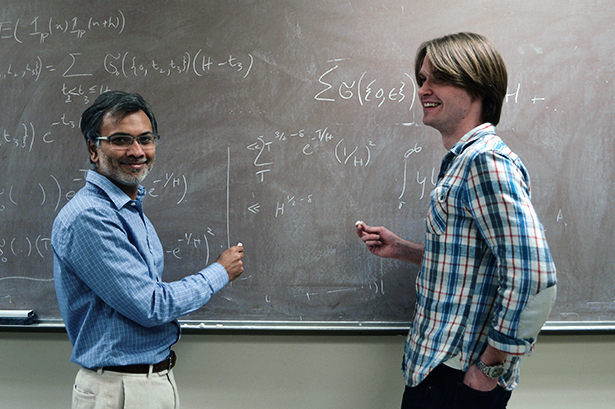
Die »Finder«: Kannan Soundararajan und Robert Lemke Oliver in Stanford im Februar 2016. Foto Waheeda Khalfan
   So. Was ist Sache?
   Primzahlen – die bekanntlich je größer desto seltener sind – haben nach­ein­an­der bestimmte Endziffern lieber als andere. Komisch, wo man doch denkt, es ginge bei ihnen zufällig zu wie bei anderen zusammengewürfelten Zahlen auch. 
   Ist man erst einmal über die einstelligen Primzahlen (2, 3, 5 und 7) hinaus, so können sie (in Dezimaldarstellung) nur mehr mit …1, …3, …7 oder …9 enden. Das weiß fast jeder, weil gerade Zahlen, …2, …4, …6, …8 und …0, immer durch 2; und …5 und …0 durch 5 zu teilen gehen. Man musste nun annehmen, dass – wie beim Würfeln die 1, 2, 3, 4, 5, 6 – diese übrig­ge­blie­benen vier Primzahlendziffern 1, 3, 7 und 9 unabhängig von der vor­her­ge­hen­den Primzahl und ihrer Endziffer auftreten. Ist aber nicht so! Zum Beispiel folgt auf eine mit 9 endende Primzahl statt mit 1 aus 4 (25%) statistisch ausprobiert mit hoher, 65-prozentiger Wahrscheinlichkeit eine mit 1 endende (wie schon auf 9 die 11). Herausgefunden und am 13. März 2016 ver­öffent­licht haben das Kannan Soundararajan und Robert Lemke Oliver an der Stanford Universität. 

Ein Münzwurfparadoxon?

Wie kommt man zu sowas? Im Original: “Soundararajan was drawn to study consecutive primes [aufeinanderfolgende Primzahlen] after hearing a lecture at Stanford by the mathematician Tadashi Tokieda, of the University of Cambridge, in which he mentioned a counterintuitive property of coin-tossing [Münzenwerfen]: 
   “If Alice tosses a coin until she sees a head followed by a tail, and Bob tosses a coin until he sees two heads in a row, then on average, Alice will require four tosses while Bob will require six tosses (try this at home!), even though head-tail and head-head have an equal chance of appearing after two coin tosses.” 
   Stichwort ist counterintuitive, kontraintuitiv, schon fast widersinnig:
   Sechsmal im Durchschnitt wird einer (hier oben Bob) eine Münze werfen müssen, bis zweimal hintereinander Kopf fällt, aber nur viermal, bis Wappen direkt auf Kopf folgt (Alice). – »Wieso?«, das fragt doch einmal euren Mathelehrer nach den endlosen gymnasialen Wahrscheinlichkeitsaufgaben mit Äpfeln in Säcken, die man teils isst, teils wieder zurücklegt. Das ist aber was anderes. Alice: Wappen nach Kopf, 2 · (1 : 2). Bob: 3 · (1:2)?.  Mehr unten.
   “It’s crazy”, soll Andrew Granville, Zahlentheoretiker an der Uni Montreal und am Londoner University College, zur unerwarteten Prim­zahl­folgen­vor­liebe gesagt haben. Mehr sag’ ich auch nicht. Man wird ja sehen, wozu’s gut ist. Bei Interesse möge man bitte den Originalartikel lesen.

Und noch eine Bitte. Bei der großen Mersenne-Primzahlensuche mitmachen. Mehr hier, Mitmachen hier, kost’ nix.

Links
Quanta-Origialartikel
https://www.quantamagazine.org/20160313-mathematicians-discover-prime-conspiracy/

Bob und Alice. Wo liegt der Unterschied?
  Alice (K ... Kopf, W ... Wappen) will KW, wirft zweimal, Möglichkeiten: 
      WK – Damit kann sie weitermachen.
      WW – Muss nun neu beginnen!
      KK – Sie kann auch damit weitermachen.
      KW – Sie hat ihr Ziel erreicht.
   Bob will KK, wirft zweimal, seine 4 Möglichkeiten:
      WK – Kann weitermachen.
      WW – Muss neu einsteigen.
      KK – bingo!
      KW – Muss neu einsteigen.
   Alice kann in 2 von 4 Fällen das Vorergebnis nutzen, Bob nur in einem. “In other words: Alice’s score couldn’t fall back to 0 while Bob’s score could. That’s where the unequal chances come from. No paradox. Just unfair conditions for Bob”, meint Der Schweizer Pokerspieler Dominic Dietiker in The Coin Paradox Demystified und sogar Re-Demystified.

https://news.ycombinator.com/item?id=11282850
The coin paradox

Dieser Blogeintrag steht auf http://j.mp/2RLgcrU
= http://blogabissl.blogspot.com/2016/07/primzahl-kollegen.html
Direkteinstieg zum Münzwurf-Paradoxon #Paradoxon

1. Juli 2016

GEO-IP Filter Alert wegbekommen, ausschalten

Beim Aufruf einer IP-Adresse (URL) erscheint:

This site has been blocked by the network administratrator.
Block reason: Gateway GEO-IP Filter Alert
IP address: ---.---.---.--
Connection initiated from country: Germany


Früher war die Adresse immer gut erreichbar gewesen.
   Was tun?

Hier eine Anleitung für Firefox 

Helfen tat’s nicht, denn:

Hinweis: Achten Sie aber, dass nach der Deaktivierung dieser Funktion das Standortbezogenes Surfen nicht ganz abgeschaltet, sondern nur eingegrenzt ist. An Hand   ihrer IP-Adresse lässt sich jedoch ihr Land und ihre Stadt immer noch auslesen.  

Aufgetreten war’s mit http://soquel.sccs.net/

Why you need an organization to go to school in the USA …

… and some more tipps for a US “student exchange”. (“Exchange” does not necessarily mean a reciprocal arrangement, where you would have to host an American here in Europe!)
US Driver License from 2000,
issued to my then 16 years old daughter
Back in 2000 I had organized a year of high school for my daughter, then 16, in Colorado – without the help of an “organization”, i.e. without paying that extra fee.
   The arragements with the host family were private. The school had to be payed tuition though. They sent me a signed form, to be checked by the US visa authorities. But that’s another story, that’s past.
   Her Wyoming driver license was later exchanged for a German one. Read the story (German). – That saved us a lot of money!

Today, after 9/11/2001, US visa have become much more difficult to get. There still are visa that you can get only with a school’s signature: F1 visa.
   F1-visa are for private high schools only, not for public high schools. The schools must have gone through a costly check. “Before you can apply at a U.S. Embassy or Consulate for an F or M student visa, you must first apply to and be accepted by a SEVP approved school”, says http://travel.state.gov/content/visas/english/study-exchange/student.html. 
   The problem is “SEVP approved”! SEVP stands for “Student and Exchange Visitor Program”; ICE for “Immigration and Customs Enforcement”. Here you should find SEVP-schools: https://studyinthestates.dhs.gov/school-search.
   In our case this would have meant one of two rather expensive and unpractical private schools, with high yearly tuition fees; details below1). We did not further follow this option.  
   SEVP-schools are rare. And we already knew the school we wanted – our host’s children had gone there, it’s nearby, looks good on web.
   For J1-visa, the one we wanted, you need to engage a German organization with an US partner organization, because the States want close control of the student, and apparently have outsourced this. We chose Stepin here in Bonn; they are linked to Pax (“Program of Academic Exchange”) in the US. All our contacts are purely to Stepin, while our US host will have to do with Pax.

This basically is the story: “Why an organization?”

Costs: 
• Arrangement with the host family (in our case)
• Contract with the organization (in our case “Stepin”), about € 10.000 (includes flight, insurance etc.)
• Visa fee € 144 (to be paid by bank transfer2)
• SEVIS I-901 Payment (payable by credit card, even with American Express) $ 180
· No school fees with J1 (see here, German)

1) Details to the SEVP schools we found around Santa Cruz, Ca.:
The two are as follows:
1- Georgiana Kirby Preparatory school which is located in down town Santa Cruz www.kirby.org - It’s easyish to get to i.e. on the main bus transportation lines but is very small only 245 students across grades 6-12. They have an international program (so that there is academic credit I believe) but it is very expensive $23,000 tuition.
2 - Aptos High School, which is the School Board south of me, towards Watsonville www.aptoshs.net. Its student population is about 1400 in grades 9-12. The cost to attend there is cheaper $10,000 (which has to be paid before they will issue something called an I-20, which is what apparently is needed in order for you to get a visa for Carla. There the expectation is that it is much more of an “experience” year and they can’t guarantee that any of their classes would be acceptable “credit” for you locally. The challenge with Aptos High is that even though it is only a few miles away, it is off the beaten path, there is no “public” transportation to that area and it’s too far to walk, so would require organized drop off and pick up every day, which would be a challenge – not impossible – but a challenge. Unfortunate that she wouldn’t be 16, as then she could drive herself to school as necessary.

2) I paid the € 144 visa fee by standard german bank transfer. Perhaps it’s possible to pay by credit card or by immediate bank transfer (»sofort«). Our organization, Stepin, had warned that credit card payments are not possible. 
   The official “Online Banking Funds Transfer & Cash Deposit Instructions” had warned: “Do not alter the CGI Reference number AT ALL (do not include spaces or any other extra characters) or include any other information. If you do not include the CGI Reference EXACTLY AS LISTED ABOVE, your payment WILL NOT be recognized.” (»Als Verwendungszweck müssen Sie Ihre persönliche CGI-Referenznummer angeben, sonst kann Ihnen die Zahlung nicht zugeordnet werden. Sie dürfen die CGI-Referenznummer nicht verändern oder andere Informationen angeben.«). As good German I instinctively had added the keyword visa and the name of my daughter into the subject line – but that really did not matter, despite my anxieties. We were afraid, we’d already be in vacations in Italy …
   A day later I called the visa service at 032 221093243. (032 is a german VoIP-number.) I didn’t have to wait much, and they were very friendly and helpful, spoke perfect German. They offered me a choice of interview time slots in about two weeks time. (According to Stepin you can change the interview appointment time twice without extra payment.) 
   Practically in the meantime the “I-901 Payment Confirmation” had arrived via e-mail.
   The “Appointment Confirmation” prompty came as well. So everything was settled. 
   Now I had to pay SEVIS, $ 180, and get a printed confirmation to show at interview time. Stepin says payment must be done at least three days before the interview. I paid by American Express credit card.  
1" (one inch) = 2,54 cm

The biometric picture must be square (quadratisch), 2 × 2" = 5 × 5 cm, so you might have to make an extra one. See http://www.ustraveldocs.com/de/de-niv-photoinfo.asp (English) or  http://www.ustraveldocs.com/de_de/de-niv-photoinfo.asp (German). Digitally a standard German biometric picture 34 × 45 mm had been accepted.
Covered Entry (Transparent Baldaquin) to the US Consulate in Frankfurt at left. –
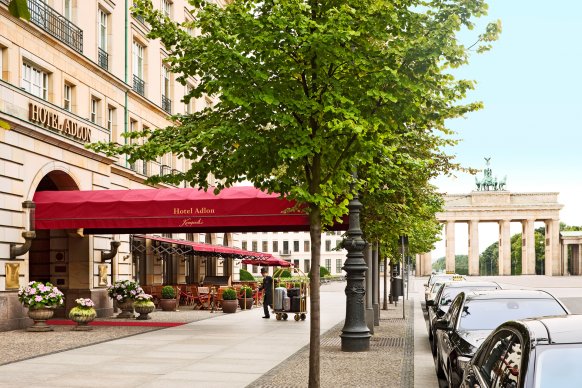
Less colorful than at the Berlin Adlon below.

The personal visit at the consulate is to be done by the student alone. You cannot accompany him or her inside the embassy.

Ganz so vornehm war’s nicht vor der amerikanischen Botschaft
in der Gießener Straße in Frankurt am Main,
auch die Umgebung etwas bescheidener.
Aber immerhin: Bei Regen hat man ein Dach drüber.
Hier etwas Werbung fürs Adlon am Brandenburger Tor,
»als Zitat«.
This visit was easy. We had started at five in the morning from Bonn. Carla’s appointment was at 7.15 in Frankfurt – first thing Monday morning. When we arrived at 6.45 a small queue was already wainting, outside, under a baldachin. Friendly german guards in american uniforms helped. Once inside the first fence, Carla showed her papers, then was asked in. In a nearby building there is a deposit for mobile phones and other stuff that must be kept out; you might not want to use that, as you’ll loose your position in the queue. After the secutity check she had to answer some simple question, rather colloquially and friendly, and could then hand in her passport and the papers. She was back within half an hour.
   Apparently the whole “personal” procedure at the consulate is in order to electronically get the fingerprints. The Americans didn’t even take her picture, just asked if the submitted one was recent, as required – the electronically transmitted jpg image in german format must have sufficed. Now we wait for the passport with the visa in (registered) mail. 
   Incidentally: memoir photos are allowed in front of the “tomb” stone announcing the Embassy, no other background please, no buildings. They aren’t architectonically pleasing, anyway.
Deatails modified
  A day later – Tuesday – Carla got a friendly mail “Document Status (US Travel Docs)”: “Dear Carla […], Your document(s) have been collected from the US Embassy/Consulate. The passport number being returned is C73YJL34R and the airway bill for tracking is RB486388627DE110 [numbers modified here, no . at end of paragraph, interesting!]. You have chosen to have your documents delivered to the following location: […]. If you have any issues or concerns, please contact us at www.ustraveldocs.com/de.”
   Two days later – Wednesday – the passport was back, via registered mail, including visa and a nice salute! US efficiency at its best.  

Stepin rules out accompaying the student to the US or even visting him or her before March 1, in our case 2017, to avoid uncontrolled separations and lasting homesickness. 

Disclaimer. These hints are to the best of my memory and conscience, but without any guarantee. Things may also be changed at any time by the authorities. So please take care yourself!
                                                                                    July 2016, comments welcome to Fritz Jörn

See my next post in this subject: US High School Parent Information, Nov.2016

Permalink:
http://blogabissl.blogspot.com/2016/07/why-you-need-organization-to-go-to.html